



An office fridge can become difficult to use long before it becomes full. Unlabelled containers, an unexplained milk bottle and a lunchbox behind somebody else’s shopping create uncertainty. The fix is usually a small system that people can follow in seconds, with a clear answer to three questions: whose food is this, when did it arrive and who handles a problem?
The aim is a usable shared facility rather than a complicated surveillance project. Start with food safety basics, then add a label and space arrangement suited to your team. A good system makes routine actions obvious and leaves fewer decisions for the person doing the Friday clean-out.
Check temperature before designing labels
A tidy fridge is not necessarily a correctly chilled fridge. The FDA’s refrigerator thermometer guidance recommends keeping refrigeration at 40°F or below, approximately 4°C, and using an appliance thermometer to monitor the actual temperature. A dial marked one through five is a control setting, not a temperature reading.
Assign the check to a named role, such as the opening receptionist or facilities rota, and record where the thermometer belongs. If its location keeps changing, the team may be comparing inconsistent readings. Have a clear route for reporting a warm appliance, damaged seal or power interruption; a label template cannot resolve equipment failure.
For a fictional six-person office, a small card beside the fridge might show the date, reading and initials of the checker. This is an organizational example, not a claim that a daily tick alone guarantees food safety. The record is useful because it identifies an observation and somebody responsible for responding.
Give each container three pieces of information
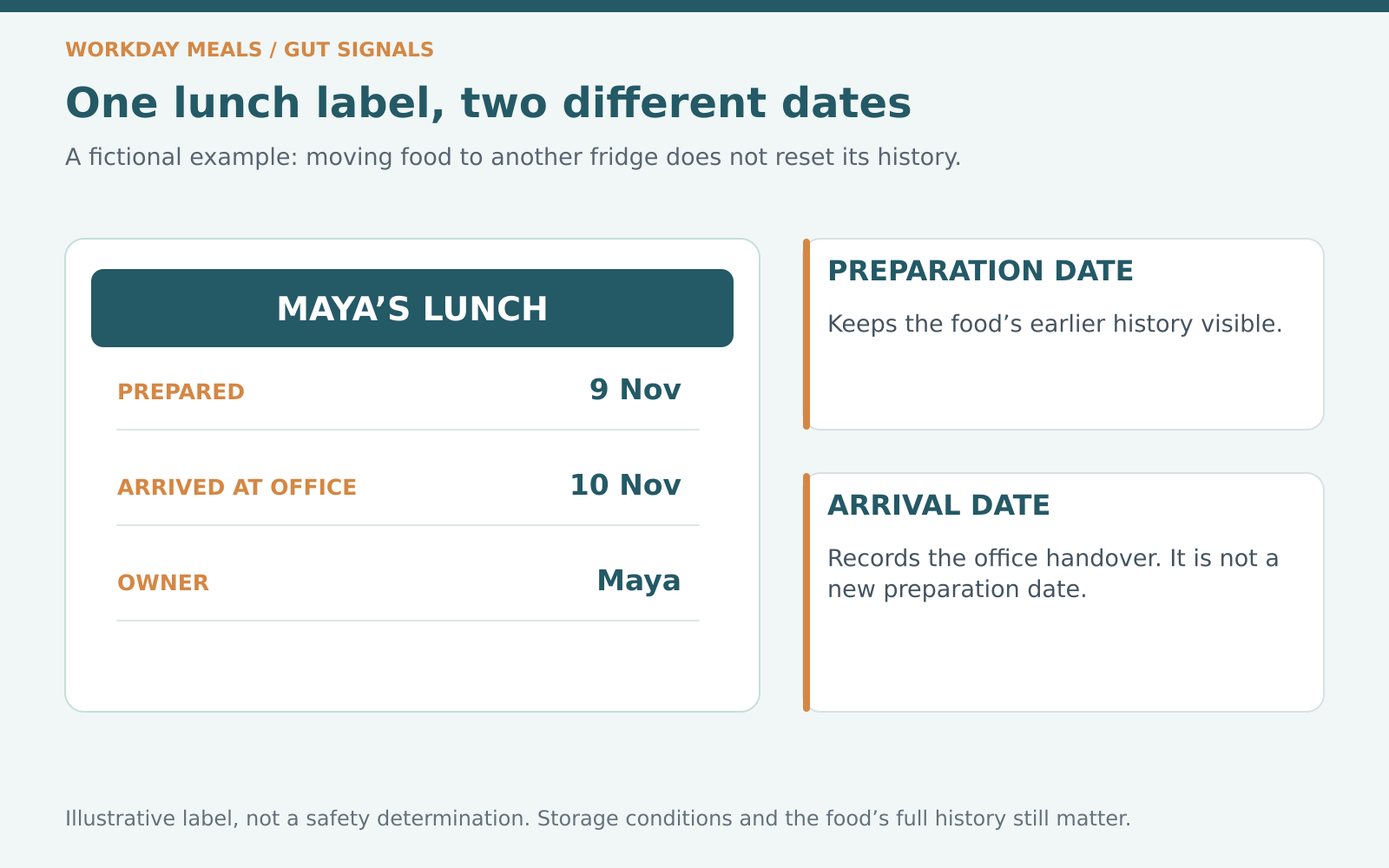
Use a name, the food’s preparation or opening date where relevant, and the date it entered the office fridge. Those dates can be different. Food prepared at home on Sunday does not become newly prepared when it is brought to work on Wednesday. Labelling only the office arrival date would conceal that history.
A simple example is “Maya — cooked Sunday 8th — brought in Monday 9th.” If the food is commercially packaged, retain the original information and storage instructions instead of covering them with a sticker. For shared supplies, identify the person or team responsible for opening and replacing the item.
Write dates unambiguously. “9 Nov” is easier for an international team to interpret than “9/11.” Place the label where it can be read without opening the container or rearranging several other lunches. Reusable labels are convenient only if the old writing is removed fully; an unreadable stack of dates defeats the system.
Keep ownership and shared access distinct
A shared appliance does not mean every item is communal. Mark one small zone for team supplies, and treat the remaining food as individually owned unless explicitly labelled otherwise. This prevents the awkward assumption that an unmarked container is available to anyone or that a half-used milk carton belongs to facilities.
Do not make a complicated shelf code that requires remembering six colours and a weekly spreadsheet. A clear “shared” marker and readable names usually convey more than an elaborate legend. If people hot-desk or work different shifts, use a stable team label rather than the desk number they happen to occupy that day.
Keep space allocation adaptable. A lunchbox and a catering delivery do not require the same arrangement. Planned deliveries should have a temporary space decision and responsible person before they arrive, so one event does not silently displace everybody’s meals.
Put storage time in the food’s full history
The USDA guidance on handling leftovers recommends prompt refrigeration, generally within two hours, reduced to one hour above 90°F, and using properly refrigerated leftovers within three to four days. That window does not reset after a commute or transfer between fridges. Cooling, transport and time outside refrigeration remain part of the same history.
For a fictional example, a meal prepared Monday evening and brought to the office Thursday is already several days old. The Thursday arrival sticker tells colleagues who placed it there; it does not establish that Thursday is the start of safe storage. This is why the preparation-date field matters.
When the history is unknown, do not turn the label into a confident guess. A question mark is a prompt to ask the owner, not permission to invent an earlier or later date. Likewise, a good smell is not a complete safety assessment. Organization should preserve information rather than replace it with reassurance.
Design the clean-out rule before it is needed
Agree who announces routine cleaning, how owners retrieve containers and what happens to unattended items. Keep that rule visible and suitable for the team’s working pattern. A Friday deadline may be inconvenient for staff who work Monday through Thursday, while a night-shift team may need a different handover.
Separate food decisions from container ownership. A colleague may want an empty reusable box returned even when its contents must be discarded. Use a designated location for cleaned or clearly separated belongings so the fridge does not become indefinite storage for abandoned containers.
A useful handover note records unresolved issues: a spill that needs attention, an appliance fault already reported or a delivery expected later. It should not contain judgments about a colleague’s eating habits. The purpose is maintaining a shared resource, not making lunch choices part of performance management.
Test the system with one ordinary week
Try the labels and arrangement for a week, then ask which step people skipped and why. If the pen repeatedly disappears, attach one nearby. If labels cannot stick to damp containers, choose an appropriate alternative. If the shared zone fills with private items, make its boundary clearer rather than writing a longer policy.
The most useful measure is whether somebody can place and retrieve food without guessing about ownership, dates or responsibility. You can count missing labels or unresolved containers as practical process observations, but do not pretend those counts measure nutritional quality or anyone’s health.
A predictable lunch setup also frees attention for more interesting food questions. Once the meal is stored and available, physiology takes over: food structure, stomach emptying and gut signals shape what happens next. Those biological processes deserve their own evidence, separate from the simple office workflow that gets lunch to the table.


 Trenbolone:
 Winstrol:
 Conclusion:


